Eminent domain compensation equals the fair market value of what the government takes, set by an appraiser using comparable sales, income, or cost methods. When only part of a parcel is taken, states add damages to the land left behind – and they calculate that addition in one of two ways. The federal "before and after" rule and the state "take plus damages" rule can produce different final numbers from identical facts, which is exactly where most negotiations get stuck.
What "just compensation" actually means

The Fifth Amendment bars the government from taking private property for public use without just compensation. The Supreme Court settled what that phrase means in practice in 1943. <cite index="17-4,17-5">In United States v. Miller, the Court described just compensation as the full and perfect equivalent in money of the property taken, then noted that courts had early on adopted market value as the practical standard for measuring it</cite>.
That standard has a specific shape. <cite index="12-6">Market value is usually described as what a willing buyer would pay in cash to a willing seller</cite> – neither one under compulsion, both reasonably informed. What the property is worth to you personally does not enter the calculation. Neither does what you paid for it, what you still owe on it, or what it would cost to find something comparable in a tighter market.
The standard also excludes value created by the project itself. <cite index="12-7">Miller held that value is fixed with consideration of all the property’s available uses, but its special value to the condemning authority – as distinguished from ordinary buyers – must be left out</cite>. A strip of your frontage may be indispensable to a highway alignment. That does not make it worth more than frontage land generally sells for.
One more distinction drives everything below: whether the agency is taking the whole parcel or just a piece of it. A full taking is a single valuation question. A partial taking is two questions, and states disagree about how to add the answers together.
How appraisers calculate fair market value

<cite index="35-8">Appraisers rely on three traditional methodologies to determine value and therefore the just compensation owed</cite>. Which one dominates depends on the property type, not on who hired the appraiser.
| Approach | How it works | Best fit | Typical weakness |
|---|---|---|---|
| Sales comparison | Adjusts recent sales of similar nearby properties for differences in size, condition, and location | Houses, vacant land, standard commercial lots | Falls apart when there are few recent comparable sales |
| Income capitalization | Converts the property’s net operating income into a value using a market capitalization rate | Apartment buildings, leased retail, warehouses, farmland under lease | Sensitive to assumptions about vacancy, expenses, and the cap rate |
| Cost | Estimates land value plus replacement cost of improvements, minus depreciation | Churches, schools, fire stations, specialty industrial buildings | Replacement cost often exceeds what any buyer would actually pay |
A competent appraisal usually tests more than one approach and then explains why one carries the most weight. The logic is the same machinery that drives how a total-loss payout gets calculated on a vehicle: find what the market actually pays for the thing, not what it means to its owner.
Both sides typically hire their own appraiser, and the two reports rarely land in the same place. <cite index="35-7">Because eminent domain itself is so hard to stop, the only issue at trial in most cases is the amount owed and whose appraisal is more credible</cite>. If you have never read a formal valuation report, it helps to understand the difference between an appraisal, inspection, and assessment before you start comparing numbers – they measure different things and are prepared for different purposes.
Full taking vs. partial taking: why the math changes

Full taking: straightforward fair market value

<cite index="10-3">When the entire property is taken, the measure of damages is the property’s fair market value at the time of the taking</cite>. One parcel, one date, one number. Disputes still happen, but they are disputes about comparables and highest-and-best-use, not about formulas.
Partial taking: value of the part taken plus damages to the remainder

<cite index="9-4,9-5,9-6,9-7">Compensation for a partial taking has two components: direct damages, meaning the value of the land and improvements actually acquired, and indirect or severance damages, meaning the loss in value to the property the owner keeps – the remainder</cite>. Severance damages cover the practical consequences of the taking: a driveway that no longer meets setback rules, parking you can no longer fit, a field now split by a right-of-way, a building pushed uncomfortably close to a widened road.
This is also where offers get thin. <cite index="9-8,9-9">Condemning authorities frequently ignore or understate the impact on the remainder, so the severance figure in the agency’s appraisal can differ sharply from what is actually owed</cite>.
Benefits cut the other way. <cite index="2-11">If the remainder is benefitted by the project, that benefit is generally subtracted from the severance damage award</cite>. <cite index="3-9">Many states allow special benefits to offset severance damages only when those benefits exceed what neighboring owners receive from the same project</cite>.
The federal before-and-after rule vs. the state take-plus-damages rule

Two formulas exist for the same partial-taking problem. The names are misleading, so start with the definitions rather than the labels.
<cite index="8-3">Under the federal rule, also called the before-and-after method – which, despite the name, is used by several states – just compensation for a partial taking is the value of the entire property before the taking less the value of the remainder</cite>. <cite index="6-1,6-2">The rule allows no separate award for severance damages that are not already captured in the difference between the before value and the after value</cite>.
<cite index="8-7">Under the state rule, also called value of take plus damages, just compensation is the value of the property taken plus the damages to the remainder</cite>. <cite index="6-3">Here the appraiser calculates a separate value for the part taken and a separate figure for severance damage to the remainder – and both rules can be available within a single jurisdiction</cite>.
Most of the time the two methods converge. <cite index="5-8">Courts have long observed that the measure of damages in partial-taking cases generally boils down to the same result as the before-and-after rule, subject to local modifications on matters such as benefits</cite>. The word "benefits" is doing heavy lifting in that sentence. The methods diverge precisely when the project increases the value of the remainder.
Here is why. <cite index="8-9,8-10">If a jurisdiction applying the before-and-after rule offsets project enhancement, an owner whose remainder is worth more after the taking than the whole property was before it recovers nothing – while under the state rule, the enhancement offsets only against the damages to the remainder</cite>. The value of the dirt actually taken survives the offset under the state rule. It does not under a strict before-and-after calculation.
<cite index="7-5,7-7">Commentators have documented cases awarding a landowner zero compensation for a partial taking under the before and after rule, because that rule permits a zero award in those circumstances</cite>. Which formula governs your case depends on your state’s condemnation statute, its constitution, and its pattern jury instructions – not on whether the project happens to be federally funded. <cite index="1-5,1-6">Michigan, for example, treats the before-and-after rule as the starting point and treats severance damages as already reflected in it, rather than as a separate line item</cite>.
Worked example: a road-widening taking on a 2-acre commercial lot
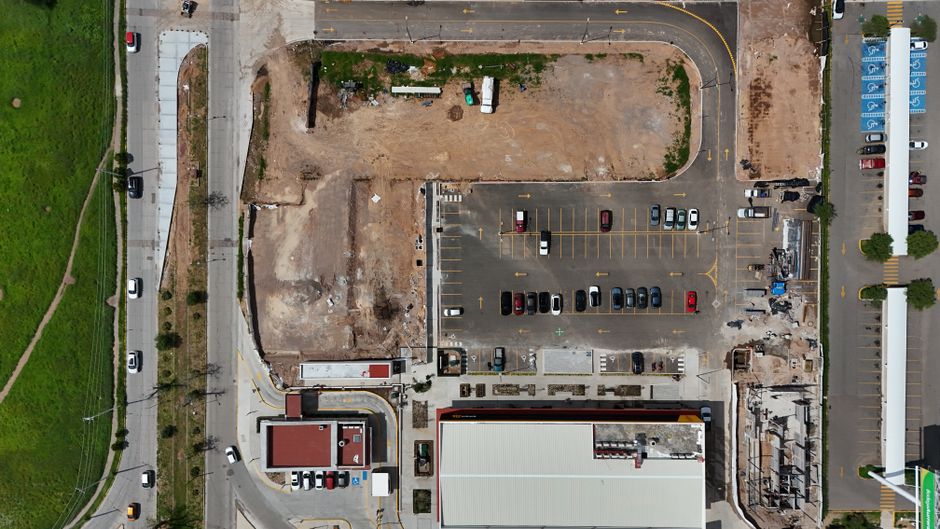
Set the facts. You own a 2-acre commercial lot with a small retail building, appraised at $800,000 before the project: $600,000 of land at $300,000 per acre, plus $200,000 of improvements. The state is widening the road and taking a 0.3-acre strip across your frontage. The strip carries $90,000 of land and wipes out 12 parking spaces and a pole sign worth $15,000. The appraiser concludes the cramped remainder loses another $60,000 in value from the lost parking and reduced setback.
Now add the twist that separates the two formulas: the widened road comes with a new signalized curb cut serving your remainder, and the appraiser values that access improvement at $75,000 – more than the $60,000 of severance damage.
| Step | Before-and-after rule | Take-plus-damages rule |
|---|---|---|
| Value of whole property before | $800,000 | not used directly |
| Value of part taken (0.3 acre + improvements) | not stated separately | $105,000 |
| Severance damage to remainder | not stated separately | $60,000 |
| Special benefit from new access | not stated separately | -$75,000, capped at the $60,000 of damages |
| Value of remainder after taking | $710,000 ($635,000 + $75,000 benefit) | not used directly |
| Just compensation | $90,000 | $105,000 |
The gap is $15,000, and it is not rounding. It is the amount by which the project’s benefit to the remainder exceeds the severance damage. Under the before-and-after formula that excess benefit keeps eating into the award, because the only thing being measured is the net change in your total position. Under the take-plus-damages formula the benefit can wipe out severance damages but stops there – the value of the land physically taken is paid regardless.
Flip the facts and the ranking flips with them. If the project created no benefit at all, both methods land on $165,000. If the remainder suffered $200,000 of severance damage and the benefit were zero, both land on $305,000. The formulas only pull apart when benefits enter the picture, which is why road widenings, interchange projects, and utility corridors generate so much more argument than clean total takings.
One practical consequence: in a take-plus-damages state, ask the appraiser to state the value of the part taken as its own line. In a before-and-after state, the fight is almost entirely about the after value of the remainder, because that single number determines the whole award.
What happens when the owner disagrees with the offer

The sequence is standardized for federally funded projects. <cite index="31-5,31-6">The acquiring agency must give the owner a written statement of the amount it established as just compensation and a summary of the basis for it, and where appropriate the compensation for the property acquired and the damages to the remaining property are to be separately stated</cite>. That written basis is the document to read first, because it reveals which formula the agency used and which comparables it chose.
From there, you can accept, negotiate, or commission your own appraisal. <cite index="35-1">If the owner does not settle, the government files an eminent domain action and just compensation is determined at trial</cite>. <cite index="35-3">The result is what practitioners call a "battle of the appraisers"</cite> – two qualified experts, two defensible methodologies, one jury deciding which story about the remainder is more plausible. The habits that help in appealing a property tax assessment transfer directly here: attack the comparables, the adjustments, and the assumptions rather than the conclusion.
Inverse condemnation is the mirror image. <cite index="40-3">It is the property owner’s cause of action against a government entity that has taken or damaged property without formal condemnation proceedings and without paying just compensation</cite> – flooding from a public drainage change, for instance, or a utility that occupies ground it never acquired. <cite index="41-3">In an ordinary condemnation the government initiates the action and deposits compensation; in inverse condemnation the owner initiates it</cite>.
Frequently asked questions

Does just compensation include moving expenses? Not as part of the valuation, but a separate federal statute covers it. <cite index="34-2,34-3">The Uniform Relocation Assistance and Real Property Acquisition Policies Act of 1970 was enacted because, until the early 1960s, people displaced by federal projects were guaranteed compensation for the property taken but had no right to reimbursement for relocation expenses</cite>. Benefits run on their own track with their own caps. <cite index="37-3">For a displaced person who owned and occupied the dwelling for at least 90 days before negotiations began, the statute authorizes an additional payment not exceeding $31,000, as adjusted by regulation</cite>.
Can the government pay less than fair market value if I refuse to negotiate? No. Refusing an offer moves the dispute to court; it does not reduce the constitutional floor. The risk of refusing is time and cost, not a smaller entitlement.
Do I owe tax on the payout? A condemnation is treated as an involuntary conversion, and gain can often be deferred by reinvesting. According to IRS Publication 544, the replacement period generally ends two years after the close of the first tax year in which any part of the gain is realized, with a longer three-year period available for condemned real property held for business or investment. The mechanics are fact-specific; a tax professional should review your figures before you rely on them.
Are attorney and appraisal fees recoverable? It depends entirely on jurisdiction. Some states shift fees to the condemnor by statute, others leave each side to pay its own. <cite index="45-11,45-12">Florida Statutes section 73.091, for example, requires the petitioning authority to pay all reasonable costs of the circuit court proceedings, including reasonable attorney’s fees and reasonable appraisal fees, subject to an exception in section 73.092(7)</cite>. Nothing like that exists in every state.
If you take one thing from the arithmetic above: find out which formula your state uses before you argue about the number. Arguing severance damages line by line in a strict before-and-after jurisdiction, or conceding a benefit offset against the part taken in a take-plus-damages state, concedes the case on the wrong ground.