Restaurant grades come from an inspector scoring specific violations – food temperature, handwashing, pest activity – during a single unannounced visit, then converting the total into a letter, a number, or a word like "Excellent." The math differs by city and state. The same kitchen could post an A in New York and a B in Los Angeles, because the two systems count in opposite directions.
That is the part almost nobody explains at the door. Below is what the inspector is actually measuring, how four real grading systems convert those measurements into a public label, and why more than 80% of graded restaurants in the country land at the top of the scale.
What is a health inspector actually scoring?
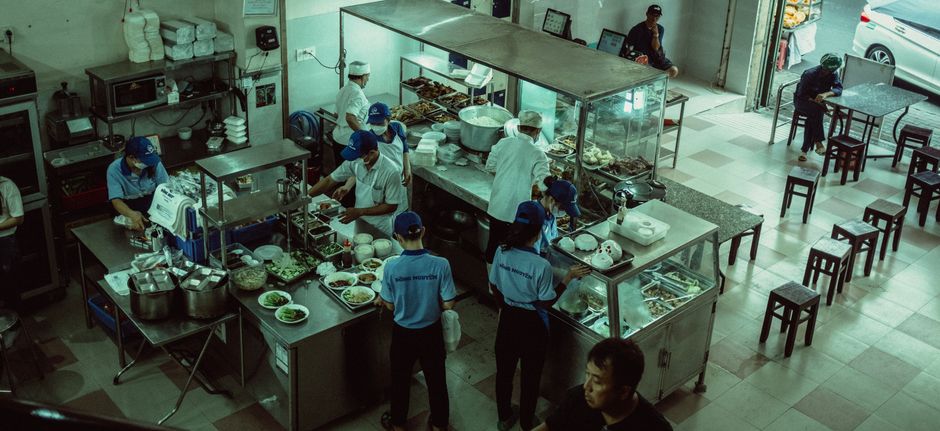
An inspection is a compliance check against a written food code, not a taste test or a general cleanliness impression. In New York City, the Health Department’s scoring guide says inspectors look at food handling, food temperature, personal hygiene, facility and equipment maintenance, and vermin control, with each violation carrying a set number of points that are totaled at the end of the visit.
Those violations sort into tiers by how directly they can make someone sick. Texas, for example, groups them into priority items (things that directly cause foodborne illness, like undercooking or an infestation), priority foundation items (a missing thermometer, a broken handwashing sink), and core items (chipped tiles, cluttered storage), per the state’s inspection marking framework. A restaurant can rack up several core violations and still score well; one priority violation can sink it.
The tier structure comes from a shared national reference. The FDA’s 2022 Food Code states plainly that the model Food Code is neither federal law nor federal regulation and is not preemptive – it is FDA’s recommended framework, which states and counties then adopt, adapt, or ignore. That single sentence explains most of the variation you’ll see between jurisdictions.
One more thing worth internalizing: the visit is a snapshot. The inspector documents what is true in that kitchen on that morning. This is a different exercise from a broad quality assessment – closer in spirit to the difference between an inspection and an appraisal, where one records observable defects on a given day and the other tries to estimate overall worth. A health inspection is firmly the first kind.
How do the major grading systems convert points into a grade?

Here is where the same underlying inspection produces wildly different-looking public results.
New York City counts up. The city’s letter grading rules set 0 to 13 points as an A, 14 to 27 as a B, and 28 or more as a C, so a low number is the good outcome. San Diego County counts down: the county’s food program starts every facility at 100 points and deducts four for a major risk factor, two for a minor risk factor, and one for a good retail practice violation, with 90 to 100 earning an A and 79 or below a failing C.
Los Angeles County uses the same 100-point direction but adds a fourth band. LAist’s breakdown of the county’s grade cards lists A at 90 to 100, B at 80 to 89, C at 70 to 79, and a numeric-only score card for anything from 0 to 69.
Seattle’s county skips letters entirely. King County’s food safety rating system assigns one of four ratings – Excellent, Good, Okay, or Needs to improve – and, critically, it is not built on one visit: for higher-risk establishments the rating averages unsafe food handling scores across the last four routine inspections, while lower-risk operations are averaged over up to two.
Texas has no single answer. Cities adopt the state inspection form and then decide what to publish. Frisco uses a straight demerit total where the best possible score is zero across 47 form items worth 1, 2, or 3 demerits each. Tarrant County weights its most critical items – the temperature-abuse group – at five demerits apiece. Neither posts a letter grade in the window the way New York does.
| System | Direction | Top tier | Bottom tier | Based on | Posted where |
|---|---|---|---|---|---|
| New York City | Points added; lower is better | A = 0-13 points | C = 28+ points | One graded inspection | Storefront grade card, required |
| San Diego County, CA | Deducted from 100; higher is better | A = 90-100 | C = 79 or below | Most recent routine inspection | Front window grade card, required |
| Los Angeles County, CA | Deducted from 100; higher is better | A = 90-100 | Score card = 0-69 | Most recent routine inspection | Grade card in most of the county |
| King County (Seattle), WA | Averaged violation scores, curved | Excellent | Needs to improve | Last 2-4 routine inspections | Window placard with rating |
| Texas (varies by city) | Usually demerits added; lower is better | 0 demerits | Varies; closure below local threshold | One inspection | Varies; often online only |
The practical consequence: a "90" is excellent in San Diego and would be a catastrophic C-plus-plus in New York. Comparing letters across state lines tells you very little.
Does an ‘A’ grade mean the food is safe?
It means the restaurant cleared a compliance bar on one day. It does not rank the restaurant against its peers in any meaningful way, because nearly everyone clears the bar.
Tulane University’s public health school cites Dr. Stueven’s Dining Grades project, which standardizes inspection scores from across the country into comparable letters, as finding that more than 80% of restaurants receive A grades. Local data runs even higher. Los Angeles County issued more than 120,000 grades between 2022 and 2024, and 96% of those inspections earned an A, with 3% getting a B and under half a percent a C.
When 96 out of 100 outcomes are identical, the grade is not a ranking. It is a filter that removes the worst performers and lumps everyone else together. A restaurant with a spotless 100 and one that scraped by at exactly 90 display the same card.
The threshold effect is worth naming, because it works the way any cutoff does – all the consequence sits at one line, and small differences on either side of it produce very different labels, much like how deductibles work as another point-in-time threshold system. Cross the line by a point and the outcome flips entirely.
Timing compounds the problem. The card shows a past inspection, and in some systems the restaurant got a second chance to produce it. NYC’s scoring guide explains that a restaurant has two chances to earn an A in each cycle: if the initial inspection scores 14 or more, the result is scored but ungraded, and an inspector returns unannounced, typically within a month, to run the graded re-inspection. A B or C also comes with a "grade pending" card the restaurant may post while it waits for a hearing.
How often are restaurants actually inspected?
Frequency is risk-based, and in some places it is grade-based too. New York City ties the calendar to the letter: according to the Hunter College NYC Food Policy Center, C-grade restaurants are inspected every three to four months, Bs every four to six months, and As only every 10 to 12 months.
Read that again from the diner’s side. The A card in the window is, by design, the one most likely to be nearly a year old, because good performance buys distance from the next visit.
Other jurisdictions run tighter cycles. King County restaurants typically get two routine inspections a year plus one unscored educational visit, and the county’s placard deliberately blends several inspections so a single good or bad day doesn’t dominate the public rating.
Risk category also drives the schedule. Operations doing complex preparation, overnight cooking, or handling raw meat and seafood sit in the highest risk tier and get seen more often than a coffee counter serving prepackaged pastries. Complaint-driven and follow-up inspections happen outside the routine schedule entirely.
How to read a grade before you decide where to eat

Start with the date, not the letter. Every graded system posts or publishes an inspection date, and in a jurisdiction where A-grade restaurants go 10 to 12 months between visits, the date tells you how much the letter is actually worth as current information.
Then go to the source data. San Diego County publishes the SD Food Info search tool for every retail food facility in the county, King County runs a public rating search, and NYC posts full inspection results online. The itemized violation list is where the useful detail lives.
A practical decision rule for reading that list:
- Weight by category, not count. Four core or good-retail-practice violations (an unlabeled bottle, a worn floor tile) carry less risk than one major risk factor like improper cooling or a hand sink out of service.
- Watch for repeats. The same violation appearing across consecutive inspections points to a systems problem rather than a bad morning.
- Check whether it was corrected on site. Many reports flag violations fixed while the inspector was standing there, which reads very differently from an uncorrected item.
- Never compare letters across jurisdictions. A Seattle "Good" and a New York "B" and a San Diego "B" were produced by three unrelated formulas.
Frequently asked questions

Can a restaurant fix a bad grade quickly? In most systems, yes. NYC’s process sends an inspector back unannounced within roughly a month after an ungraded initial inspection, and restaurants can contest violations at the Office of Administrative Trials and Hearings before a grade is finalized, per the city’s grading guide. California counties commonly re-inspect after a B or C once corrections are reported.
Why do some restaurants have no posted grade? Because posting is a local requirement, not a national one. Many Texas cities publish inspection scores online without requiring a window placard, and even within California, San Diego County notes it is among only a handful of counties using a letter grade system at all.
Does a lower grade mean I’ll get sick? No. The grade measures observed compliance with risk factors at one moment. It is a probability signal about kitchen practices, not a prediction about your meal, and King County makes the underlying point explicit: any permitted, open establishment already meets the minimum standard to operate.
Are inspection records public? Yes. Health departments treat inspection reports as public records, and most large jurisdictions run searchable databases with the violation detail behind each score.
If you only take one habit away, make it this: look up the itemized report instead of trusting the letter. The letter compresses a 40-plus item checklist into one character, and in a system where the overwhelming majority score at the top, the compression throws away nearly everything that would help you tell two restaurants apart.